La información que figura en esta web está dirigida exclusivamente al profesional facultado para prescribir, dispensar o indicar medicamentos.


Patología ⋅ Contenido ⋅ Tumores Genitourinarios
Cáncer de Vejiga Músculo Invasivo (MIBC)



El carcinoma de células uroteliales representa más del 90% de los casos de cáncer de vejiga.1,2
España es el país con mayor incidencia de CV estandarizada por edad a nivel mundial.3
El CV ocupa el 5º puesto en frecuencia de tumores, tras el cáncer de mama, pulmón, próstata y colon, estimándose una incidencia de 22.435 pacientes en 2025, siendo la causa de muerte de 4.499 pacientes en 2023 en nuestro país.4
De acuerdo con la profundidad de la invasión tumoral se pueden distinguir entre:
- Cáncer de vejiga no músculo-invasivo (NMIBC): es la fase más temprana del cáncer de vejiga. Se encuentra en el tejido que recubre la superficie interna de la misma, sin involucrar al músculo y representa alrededor del 75% de los casos.2,5
- Cáncer músculo-invasivo (MIBC o CVMI):
- Es menos frecuente y representa el 25% de los casos al diagnóstico.6 Se desarrolla a partir de la capa celular basal del urotelio. Invade la lámina propia y penetra en las capas musculares superficiales o profundas de la vejiga Igualmente, puede expandirse a los tejidos que rodean la vejiga y más allá (estadios T2a-T4b). 2,5,6
- El MIBC tiende a metastatizar con mucha más frecuencia que el NMIBC al producirse la pérdida de RB1 y PTEN, entre otras alteraciones y su abordaje es bastante más agresivo que el del NMBIC, por lo que se dificulta su curación.1
- Se asocia principalmente con cambios en los hábitos urinarios, como frecuencia y urgencia, y hematuria, detectada mediante cambios visibles en el color de la orina o mediante análisis de la misma. Estos síntomas pueden confundirse con otras patologías benignas, pero si persisten deben evaluarse para descartar MIBC.7-10
- Cáncer de vejiga metastásico: es la fase más avanzada del cáncer de vejiga, en la cual el tumor se ha extendido por los órganos y tejidos adyacentes. Representa alrededor del 5% de los casos.2,11
Es fundamental el estadiaje al diagnóstico tras la biopsia y/o la TURBT para determinar si se trata de un NMIBC o un MIBC ya que, si el tumor invade el músculo detrusor, incluso superficialmente, hay un aumento notable de la incidencia de metástasis y una disminución de la supervivencia.12-15
Existe una complicación relacionada con la estadificación incorrecta o la infra estadificación, especialmente en estadios más bajos (es decir, T2N0), debido principalmente a las dificultades en diferenciar entre enfermedad confinada al órgano y enfermedad localmente invasiva, por las limitaciones propias de la resección transuretral del tumor vesical (RTUV).16-18
Alrededor del 50% de los pacientes que fueron clínicamente clasificados como T2N0 estaban infra estadificados tras la cistectomía radical, en dos estudios retrospectivos que incluyeron más de 20.000 pacientes entre ambos.19,20
Para mejorar los resultados en cuanto al correcto estadiaje, se pueden utilizar métodos de imagen complementarios.5,21
Aunque el TAC es el método de imagen más utilizado para complementar el diagnóstico y mejorar la estadificación del cáncer de vejiga, presenta diversas limitaciones.5,21
En el MIBC el papel del comité multidisciplinar de tumores es esencial.22 los MTDs aseguran que los pacientes reciben el tratamiento más adecuado, para ello los profesionales sanitarios deben colaborar entre ellos, de manera que todos los pacientes sean tratados por el especialista adecuado.8
El tratamiento estándar para el CVMI es la cistectomía radical y desde hace más de 20 años, la adición de QT neoadyuvante basada en cisplatino para los pacicntes elegibles.23
Basándose en criterios de Galsky, se estima que aproximadamente el 30–50% de los pacientes con CVMI son inelegibles para recibir cisplatino.24
Para los pacientes no elegibles a cisplatino, no existen actualmente opciones de neoadyuvancia disponibles.
- Cistectomía radical:
Procedimiento estándar de tratamiento en la enfermedad músculo-invasiva localizada. Incluye la extirpación de la vejiga, próstata (en hombres), útero, ovarios, trompas de Falopio y parte de la vagina (en mujeres), además de hacer una linfadenectomía pélvica. La reconstrucción urinaria se suele hacer mediante desviación urinaria (ileal conduit o neovejiga ortotópica).12-15,25 Es en esta fase de la enfermedad, la cistectomía radical asociada a terapias sistémicas, se considera el tratamiento estándar para el MIBC con intención curativa, sin embargo, a pesar de las terapias locales y sistémicas agresivas, aproximadamente el 50% de los pacientes tienen una recurrencia dentro de los 3 años y una tasa de mortalidad del 50% dentro de los 5 años.26-29 En este contexto, el consenso EAU-ESMO alcanzó un 83% de acuerdo con respecto a la evaluación de todos los tratamientos curativos se debe llevar a cabo al menos por un oncólogo, un urólogo y un profesional neutral.30
- Radioterapia:
Es una alternativa a la cistectomía en pacientes que no son candidatos a cirugía. Puede combinarse con la QT como parte de un enfoque trimodal.12-15
- Quimioterapia neadyuvante:
Se ha demostrado que la QT neoadyuvante (NAC) basada en cisplatino para el MIBC puede utilizarse antes de la cirugía para reducir el tamaño del tumor, facilitando su extirpación y disminuyendo el riesgo de metástasis.18,31,32 La QT neoadyuvante ha logrado incrementar la SG a los 5 años, esta puede consistir en metotrexato, vinblastina, doxorrubicina y cisplatino (MVAC), pero la más expendida es la combinación de gemcitabina y cisplatino.13-15, 22,25,31
El beneficio de la NAC en la SG es especialmente notable en pacientes que consiguen un ypT0 or ≤ ypT2.13-15,22,25,31
Los pacientes que responden bien a la QT neoadyuvante tienden a tener mejores resultados y una mejor supervivencia global, especialmente si responden completamente.33
- Quimioterapia adyuvante:
La QT adyuvante se reserva para pacientes con alto riesgo de recurrencia. Esto incluiría pacientes con enfermedad extravesical y aquellos con ganglios linfáticos positivos en el momento de la cirugía que no recibieron QT neoadyuvante.13-15,22,25,31 En este contexto, nivolumab, un inhibidor de puntos de control inmunológico está indicado en monoterapia para el tratamiento adyuvante de adultos con MIBC con expresión de PD‑L1 en células tumorales ≥ 1%, con alto riesgo de recurrencia después de someterse a resección radical del carcinoma urotelial de músculo invasivo (CUMI).34
- Tratamiento perioperatorio:
Es administrado tanto antes como después de la cirugía para reducir el tamaño del tumoe y disminuir el riesgo de recirrencia postoperatoria de la enfermedad.35 El abordaje perioperatorio está recomendado para mejorar el prónóstico en los pacientes con MIBC, con caracter preferente según las guías SEOM 2025.7-9-36 Durvalumab es la primera y única IO con aprobación en EMA para esta indicación. 32
Las guías de práctica clínica en oncología desde la NCCN para cáncer de vejiga recomiendan el régimen NIAGARA (durvalumab neoadyuvante en combinación con GC seguido de durvalumab adyuvante) como una opción de tratamiento para pacientes con CVMI en estadio II (cT2, N0) y estadio IIIA (cT3, N0; cT4a, N0; cT1-cT4a, N1).7
Es considerado un régimen preferente y ha sido incluido como recomendación de categoría 1.7
Las guías de la EAU han incluido la quimio-inmunoterapia neoadyuvante (inmunoterapia más gemcitabina y cisplatino), así como la inmunoterapia adyuvante, como opciones de tratamiento para el manejo de pacientes con cáncer urotelial de vejiga T2-T4a N0M0.21
La Escala de Magnitud de Beneficio Clínico de la Sociedad Europea de Oncología Médica (ESMO-MCBS v1.1 otorgó al régimen NIAGARA la puntuación ‘A’, utilizando el formulario de evaluación 1, que evalúa terapias potencialmente curativas.37
El abordaje perioperatorio combinando QT basada en cisplatino y durvalumab, está recomendado con caracter preferente en las guías SEOM 2025. 36
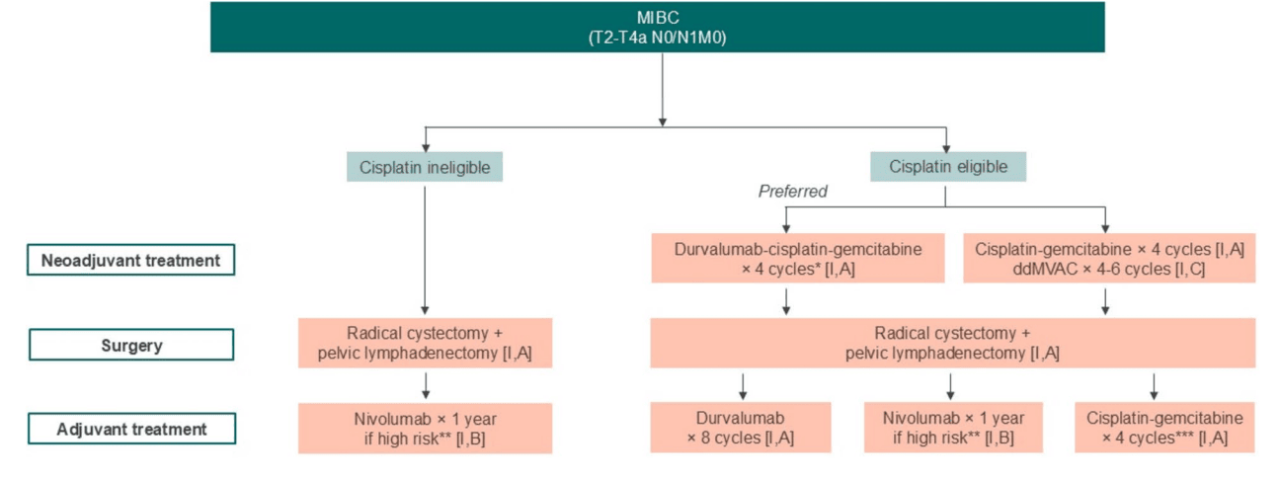
Figura de SEOM–SOGUG clinical guideline for urothelial cancer (2025)36
Fig. 1 Management of patients with muscle-invasive bladder cancer. ddMVAC: dose-dense methotrexate, vinblastine, doxorubicin, and cisplatin; EMA: European Medicines Agency; MIBC: muscleinvasive bladder cancer; PD-L1: programmed cell death-ligand 1. *Approved by the EMA, not reimbursed in Spain. **ypT≥2 and/or ypN+ and PD-L1+. In patients without prior chemotherapy, ypT≥3 and or pN+, and PD-L1+. ***For patients without prior neoadjuvant chemotherapy
El pronóstico del cáncer de vejiga depende del estadio patológico y el grado del tumor en el momento del diagnóstico. 12-15
Respecto al estadio patológico a medida que avanza, la supervivencia se reduce. 12-15
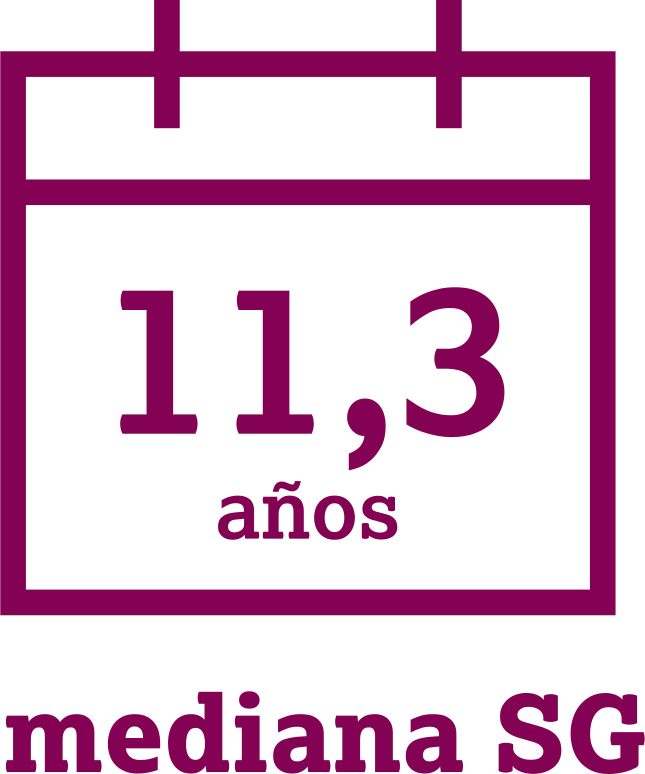
En pacientes con enfermedad pT0 la mediana de SG es de 11,3 años, pero en el caso del MIBC baja notablemente:12-15
- 6,25 años en los pT2
- 2 años en los pT3/T4
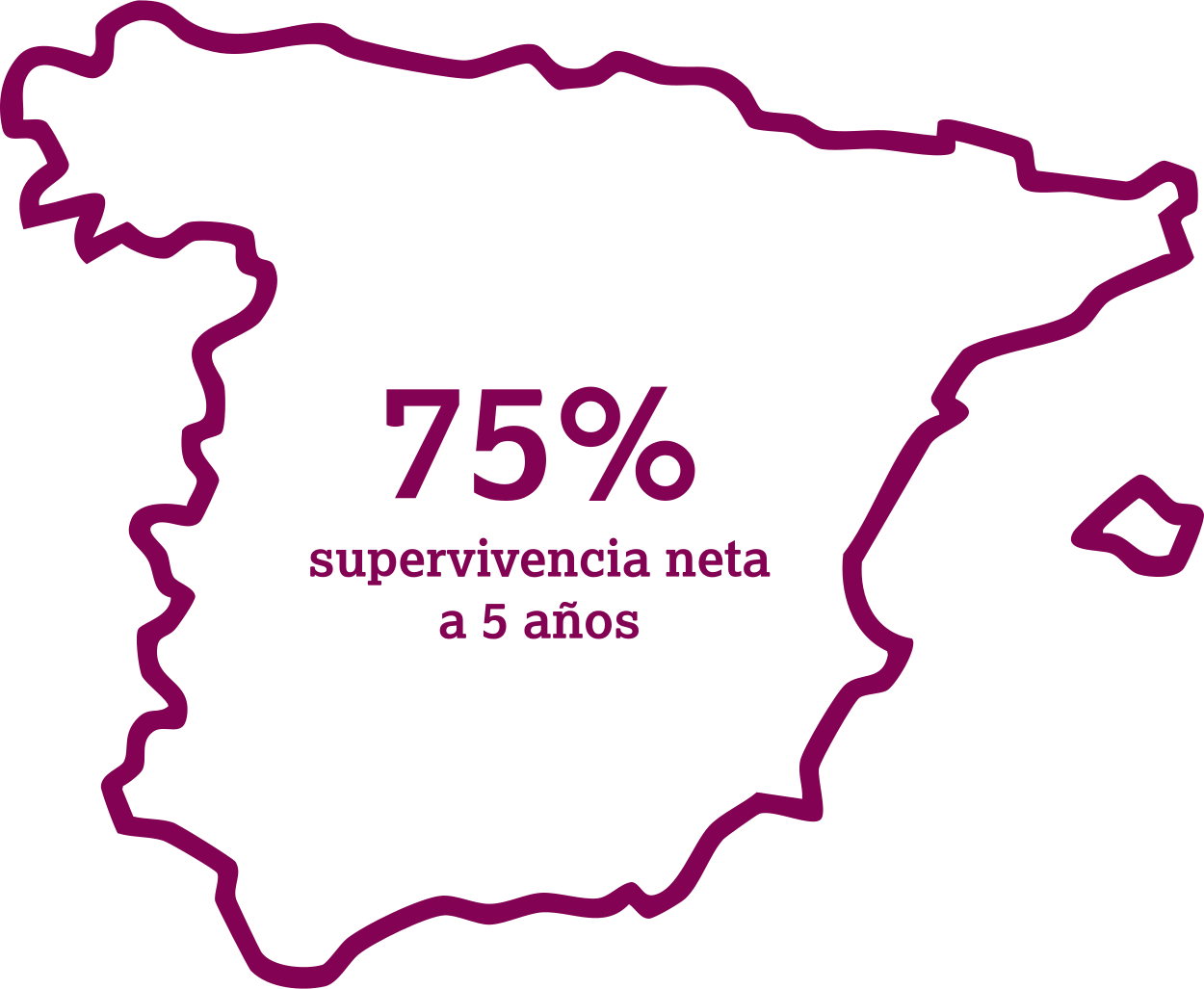
La tasa de supervivencia neta a 5 años del cáncer de vejiga en nuestro país está en torno al 75% (73,8% hombres y 75,9% mujeres),4 pero nuevamente en el MIBC es inferior:
- 50-60% en pacientes tratados con cistectomía radical.34-35
- Los pacientes con MIBC que se sometieron a NAC con cistectomía radical se mantienen en torno al 50%, lo que indica que la NAC seguida de CR es insuficiente para alcanzar un objetivo curativo.7,27,28,38,39
- Generalmente inferior al 10%, en pacientes metastásicos, aunque ha mejorado con los avances en estrategias terapéuticas.40
CUMI: carcinoma urotelial músculo invasivo; CV: cáncer de vejiga; IO: inmunoterapia; LOH: pérdida de heterocigosidad; Mb: megabase; MIBC: cáncer de vejiga músculo-invasivo; MTD: comité multidisciplinar; NAC: quimioterapia neoadyuvante; NMIBC: cáncer de vejiga no músculo-invasivo; QT: quimioterapia; RM: resonancia magnética; RTUV: resección transuretral del tumor vesical; SEOM: Sociedad Española de Oncología Médica; SLE: supervivencia libre de eventos; TAC: tomografía axial computarizada; TURBT: Resección Transuretral de Tumor Vesical.
1. Leslie SW, Soon-Sutton TL, Aeddula NR. Bladder Cancer. [Updated 2024 Aug 15]. In: StatPearls [Internet]. Treasure Island (FL): StatPearls Publishing; 2025 Jan-. Disponible en: https://www.ncbi.nlm.nih.gov/books/NBK536923/ Acceso julio 2025
2. American Cancer Society: Key Statistics for Bladder Cancer. [Internet] [Acceso junio 2025] Disponible en: <https://www.cancer.org/cancer/types/bladder-cancer/about/key-statistics.html. Acceso julio 2025>;
3. World Cancer Research Fund: https://www.wcrf.org/preventing-cancer/cancer-statistics/bladder-cancer-statistics/
4. SEOM. Las cifras del cáncer en España 2025. Disponible en: https://seom.org/images/LAS_CIFRAS_DMC2025.pdf. Acceso julio 2025
5. American Cancer Society: What is bladder cancer? [Internet] [Acceso junio 2025] Dispoible en: https://www.cancer.org/cancer/bladdercancer/about/what-is-bladdercancer. Acceso julio 2025
6. Holzbeierlein JM, Bixler BR, Buckley DI, et al. Diagnosis and Treatment of Non-Muscle Invasive Bladder Cancer: AUA/SUO Guideline: 2024 Amendment. J Urol. 2024 Apr;211(4):533-538.
7. NCCN Guidelines Bladder Cancer Version 1.2025 — March 25, 2025 https://www.nccn.org/professionals/physician_gls/pdf/bladder.pdf . Acceso julio 2025;
8. Witjes JA, Bruins HM, Carrión R, et al. EAU Guidelines on Muscle-Invasive and Metastatic Bladder cancer. European Association of Urology. 2024.
9. Powles T, et al. Bladder cancer: ESMO Clinical Practice Guideline for diagnosis, treatment and follow-up. Ann Oncol. 2022;33(3):244–258.
10. Bladder Cancer Signs and Symptoms. Disponible en: https://www.cancer.org/cancer/types/bladdercancer/detection-diagnosis-staging/signs-and-symptoms.html. Acceso julio 2025
11. GLOBOCAN Cancer Stats Facts: Bladder Cancer. Disponible en: https://seer.cancer.gov/statfacts/html/urinb.html. Acceso julio 2025
12. Chang SS, et al. Treatment of Non-Metastatic Muscle-Invasive Bladder Cancer: AUA/ASCO/ASTRO/SUO Guideline. J Urol. 2017;198(3):552-559.
13. Alfred Witjes J, et al. European Association of Urology Guidelines on Muscle-invasive and Metastatic Bladder Cancer: Summary of the 2023 Guidelines. Eur Urol. 2024;85(1):17-31.
14. Powles T, et al. ESMO Clinical Practice Guideline interim update on first-line therapy in advanced urothelial carcinoma. Ann Oncol. 2024;35(6):485-490.
15. Aragon-Ching JB, Werntz RP, Zietman AL, Steinberg GD. Multidisciplinary Management of Muscle-Invasive Bladder Cancer: Current Challenges and Future Directions. Am Soc Clin Oncol Educ Book. 2018;38:307-318.
16. Adamczyk P, Pobłocki P, Kadlubowski M, et al. A Comprehensive Approach to Clinical Staging of Bladder Cancer. N Engl J Med. 2024;11(3):761.
17. Bostroma PJ, Rhijna B, Fleshner N, et al. Staging and Staging Errors in Bladder Cancer. Eur. Urol. 2010;9:2-9
18. Lee CH, Tan CH, Faria SC, et al. Role of imaging in the local staging of urothelial carcinoma of the bladder. AJR Am J Roentgenol. 2017Jun;208(6):1193-1205.
19. Svatek RS, et al. BJU Int . 2011;107(6):898-904
20. Gray PJ, et al. Int J Radiat Oncol Biol Phys. 2014;1;88(5):1048-56
21. van der Heijden E A.G. et al. EAU Guidelines on Muscle-invasive and Metastatic Bladder Cancer. Disponible en: https://d56bochluxqnz.cloudfront.net/documents/full-guideline/EAU-Guidelines-on-Muscle-Invasive-Bladder-Cancer-2025.pdf Acceso julio 2025.
22. Multi-disciplinary Team (MDT) Guidance for Managing Bladder Cancer. https://www.baus.org.uk/_userfiles/pages/files/Publications/MDT%20Guidance%20For%20Managing%20Bladder%20Cancer%202013.pdf. Acceso julio 2025
23.Hermans TJN, Voskuilen CS, Van der Heijden MS, et al. Neoadjuvant treatment for muscle-invasive bladder cancer: The past, the present, and the future. Urologic Oncol. 2017;36:413-422.
24.Galsky MD, Hahn NM, Rosenberg J, et al. The Lancet Oncology. 2011;12(3):211-214.
25. Stage IV bladder cancer. Disponible en: <https://www.texasoncology.com/types-of-cancer/bladder-cancer/stageiv-bladder-cancer. Acceso julio 2025>
26. Park JC, Citrin DE, Agarwal PK, et al. Multimodal management of muscle-invasive bladder cancer. Curr Probl Cancer. 2014 May-Jun;38(3):80-108.
27. Hu J. Chen J, Ou Z, Chen H, et al. Neoadjuvant immunotherapy, chemotherapy, and combination therapy in muscle-invasive bladder cancer: A multi-center real-world retrospective study. Cell Rep Med. 2022 Nov 15;3(11):100785
28. Lee Y, Kim YS, Hong B, et al. Comparison of clinical outcomes in patients with localized or locally advanced urothelial carcinoma treated with neoadjuvant chemotherapy involving gemcitabine-cisplatin and high dose-intensity MVAC. J Cancer Res Clin Oncol 2021;147:3421-9.
29. Abufaraj M, Gust K, Moschini M et al. Management of muscle invasive, locally advanced and metastatic urothelial carcinoma of the bladder: a literature review with emphasis on the role of surgery. Transl Androl Urol. 2016;5:735-744.
30. Packiam VT. Consensus statements from the EAU-ESMO collaboration for advanced and variant bladder cancer: can we move the needle to improve survival? Transl Androl Urol.
31. Mari A, et al. World J Urol. 2018;36:150–E170.
32. Esteban-Villarrubia J, Torres-Jiménez J, Bueno-Bravo C, et al. Current and Future Landscape of Perioperative Treatment for Muscle-Invasive Bladder Cancer. Cancers (Basel). 2023 Jan 17;15(3):566.
33. Voskuilen CS, et al. Multicenter Validation of Histopathologic Tumor Regression Grade After Neoadjuvant Chemotherapy in Muscle-invasive Bladder Carcinoma. Am J Surg Pathol. 2019;43(12):1600-1610.
34. Ficha técnica Opdivo, Bristol‑Myers Squibb Pharma EEIG.
35. Powles T, Catto JWF, Galsky MD, et al. Perioperative Durvalumab with Neoadjuvant Chemotherapy in Operable Bladder Cancer. N Engl J Med. 2024 Nov 14;391(19):1773-1786.
36.Puente J, Rodríguez-Vida A, Sevillano E, et al. SEOM-SOGUG clinical guideline for urothelial cancer (2025). Clin Transl Oncol. 2025 Sep 17.
37.European Society for Medical Oncology (ESMO). ESMO-MCBS Scorecards for Solid Tumors: Durvalumab NIAGARA. ESMO website. Disponible en: https://www.esmo.org/guidelines/esmo-mcbs/esmo-mcbs-for-solid-tumours/esmo-mcbs-scorecards. Acceso julio 2025
38. Roviello G, Catalano M, Santi R, et al. Neoadjuvant Treatment in Muscle-Invasive Bladder Cancer: From the Beginning to the Latest Developments. Front Oncol. 2022 Jul 22;12:912699.
39. Mancini, Righetto M, Noessner E. Checkpoint Inhibition in Bladder Cancer: Clinical Expectations, Current Evidence, and Proposal of Future Strategies Based on a Tumor-Specific Immunobiological Approach. Cancers (Basel). 2021 Nov 29;13(23):6016.
40. van Ginkel N, Hermans TJN, Meijer D, et al. Survival outcomes of patients with muscle-invasive bladder cancer according to pathological response at radical cystectomy with or without neo-adjuvant chemotherapy: a case-control matching study. Int Urol Nephrol. 2022;54(12):3145-3152.
ES-27241 Octubre 2025

Consentimientos
Estos consentimientos son obligatorios para iniciar sesión. Por favor, acéptalos para continuar.


